
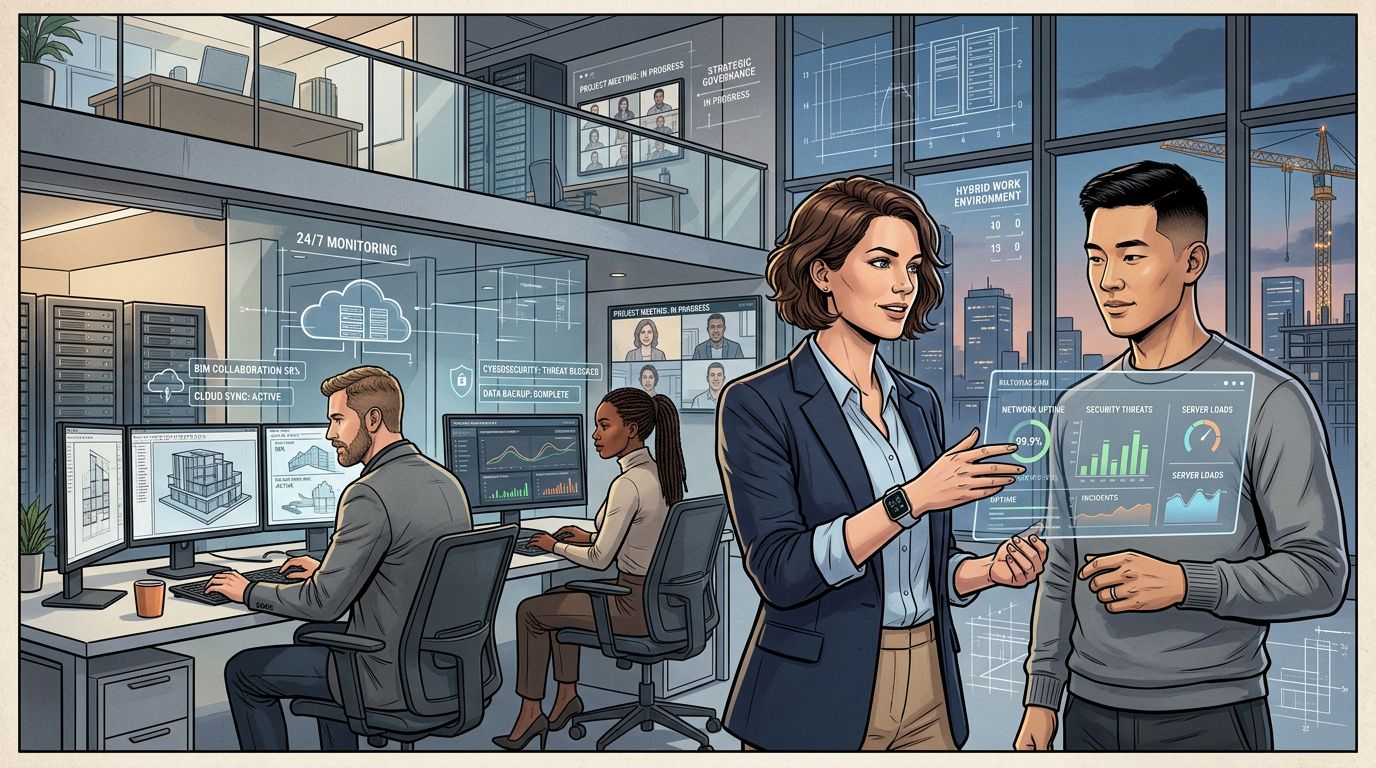
If your internal IT staff spend more time putting out fires than enabling growth, your business has already fallen behind and needs managed IT services for AEC. Reactive IT support creates a cycle where teams are constantly responding to incidents rather than strengthening systems, planning strategic improvements, or enabling the operational efficiency that drives competitive advantage. When technology teams are stretched thin managing daily emergencies, the broader business loses momentum, deadlines become uncertain, and critical infrastructure remains vulnerable to the next inevitable disruption.
The difference between reactive troubleshooting and proactive IT management isn’t just about response times. It’s about whether your technology environment actively supports project delivery or quietly undermines it through constant friction, unplanned downtime, and staff burnout. Architecture, engineering, and construction firms operate within tight deadlines and complex collaboration requirements where IT failures don’t just inconvenience users—they delay projects, strain client relationships, and expose commercial risk.
NexSys offers managed services designed to shift firms from constant firefighting to structured operational maturity. This article examines why reactive IT cultures fail to scale, how proactive managed services reduce disruption and burnout, and what strategic technology partnerships enable when internal teams are freed to focus on innovation rather than incident response. Lets discover why more AEC firms are discovering what they can achieve with managed IT services for AEC firms.
From Firefighting to Future-Proofing: The Shortcomings of Reactive IT
Reactive support models create cascading operational problems that extend far beyond the initial incident. When IT teams operate in constant crisis mode, the business loses both immediate productivity and long-term strategic capability.
The True Cost of Constant Troubleshooting
Every hour your IT staff spend diagnosing network failures or resetting user credentials represents time not spent on projects that actually move the business forward. The financial impact compounds quickly. Unplanned downtime disrupts project timelines, delays client deliverables, and forces expensive overtime to recover lost ground.
Reactive IT cycles lead to unexpected costs and unplanned downtime. Your team works harder without gaining ground because they’re perpetually addressing symptoms rather than underlying system weaknesses. Budget forecasting becomes nearly impossible when you cannot predict what will break next or how much emergency remediation will cost.
The lack of operational clarity means leadership cannot accurately assess whether technology investments deliver value or simply keep existing systems limping along.
Burnout and Operational Bottlenecks
IT professionals trapped in firefighting mode experience chronic stress that degrades both performance and retention. When your senior technicians spend their expertise on routine password resets and printer troubleshooting, you waste specialised knowledge on low-value tasks.
This creates dangerous single points of failure. Critical infrastructure knowledge becomes siloed within individuals who have no time to document processes or train others. When these team members leave—and burnout accelerates turnover—institutional knowledge disappears with them.
Your best technical staff joined to solve complex problems and build robust systems. Instead, they’re managing an endless queue of urgent tickets that prevent any meaningful progress. That frustration drives talent to organisations that offer strategic innovation opportunities rather than perpetual crisis management.
How Recurring Patterns Drain Productivity
The same issues surface repeatedly because reactive support addresses immediate problems without investigating root causes. Your team fixes the same server authentication failure monthly, restarts the same temperamental application weekly, and resets the same network configuration after every minor change.
These recurring patterns signal systemic weaknesses that demand architectural attention. Without time to analyse trends or implement preventative measures, your IT function becomes a treadmill of repetitive tasks that deliver no lasting improvement.
Higher performance remains impossible when teams lack bandwidth for optimisation, testing, or strategic upgrades. You cannot innovate when 80% of available hours go toward keeping existing systems barely functional.
Strengthening Business Resilience with Proactive Managed IT Services for AEC
Resilience isn’t built during an outage. It’s developed through structured governance, strategic planning, and continuous operational refinement that turns infrastructure into a competitive advantage rather than a recurring liability.
Operational Visibility and Service Governance
Without clear operational visibility, your IT environment operates as a black box. Issues emerge without warning, performance degradation goes undetected, and decision-making relies on anecdote rather than data. Service governance frameworks establish measurable accountability across infrastructure, applications, and support delivery.
Structured reporting provides leadership with tangible insight into system health, ticket resolution trends, and recurring failure points. This visibility allows you to identify patterns before they escalate into critical failures. When managed services shift from reactive models to intelligence-driven service delivery, they create a foundation where problems are anticipated rather than discovered during production hours.
Governance also introduces consistency. Service level agreements, escalation protocols, and documented procedures replace ad hoc responses with repeatable processes that reduce mean time to resolution and minimise disruption.
Strategic Reviews for Continuous Improvement
Technology environments degrade without intentional maintenance. Strategic reviews transform managed services from passive support into active improvement mechanisms that align infrastructure with evolving business requirements.
Regular assessments evaluate system performance, capacity planning, licensing optimisation, and workflow bottlenecks. These reviews identify where infrastructure constrains productivity and where targeted investment delivers measurable return. Intelligence-driven improvement replaces guesswork with evidence-based planning.
Your internal team gains clarity on what requires attention, what can be deferred, and what should be retired. Strategic reviews also surface emerging risks before they compromise operations, allowing you to address vulnerabilities during planned maintenance rather than emergency response. A strategic review is just one of the many services NexSys provides as part of its managed IT services for AEC firms.
Enhancing Security Posture and Risk Management
Security failures don’t announce themselves. Vulnerabilities accumulate silently until they’re exploited, and proactive risk management supports business resilience by identifying exposures before they become incidents.
Managed services extend security beyond antivirus and firewalls. Continuous monitoring detects anomalies in real time, patch management eliminates known vulnerabilities, and access governance ensures that permissions align with current roles. Your security posture strengthens through layered defence rather than reactive remediation.
Risk management also includes business continuity planning. Backup verification, disaster recovery testing, and failover procedures ensure that critical systems remain accessible during disruption. When infrastructure is managed proactively, resilience becomes embedded rather than aspirational.
Elevating Internal IT: Partnering with Technology Specialists
Internal IT teams perform best when they’re supported by external specialists who handle complex escalations and infrastructure management. This partnership model creates operational clarity, reduces burden on in-house staff, and establishes clear accountability for critical systems.
Co-Managed Services and Specialist Escalation
Your internal IT team shouldn’t be expected to master every technology stack or troubleshoot every vendor-specific issue. Co-managed services fill capability gaps by providing access to technology specialists who handle complex escalations, infrastructure design, and vendor management.
When a network outage occurs at 2am or a security incident requires immediate forensic analysis, specialist escalation ensures the right expertise responds without delay. Your team retains control of daily operations whilst external specialists manage the technical depth that internal resources can’t reasonably maintain.
This model works particularly well for AEC firms running specialised design software, rendering farms, and project collaboration platforms. These environments demand expertise that extends beyond general IT support. Managed services provide that depth without the cost of hiring multiple specialists full-time.
Defined Roles for Operational Clarity
Ambiguity about who handles what creates delays, duplicated effort, and accountability gaps. Clear service boundaries between internal teams and managed services partners eliminate confusion during incidents and routine operations.
Your internal staff focus on user support, application management, and business-specific systems. External partners handle infrastructure monitoring, security patching, backup validation, and vendor escalations. Documentation of these roles ensures everyone knows the escalation path when issues arise.
Regular service reviews maintain this clarity as your technology environment evolves. When new systems come online or business priorities shift, roles adjust accordingly. This prevents the common scenario where critical tasks fall through gaps because neither party assumed responsibility.
Empowering Internal Teams for Higher Performance
When external specialists handle reactive troubleshooting and infrastructure management, your internal IT staff can focus on projects that actually improve business operations. They move from constant firefighting to strategic initiatives like workflow automation, system integration, and user training.
This shift improves job satisfaction and retention. IT professionals want to solve business problems, not reset passwords and chase hardware failures all day. Giving them time for meaningful work reduces burnout and turnover.
Your team also gains access to specialist knowledge through the partnership. They learn from external engineers during collaborative projects and escalations, building capability without formal training programmes. This knowledge transfer creates a stronger internal team over time.
Managed IT Services for AEC: Optimising Infrastructure and On-the-Ground Support
Proactive infrastructure management requires both remote oversight and physical presence. Environments degrade without structured monitoring, while field deployments and hardware changes demand coordinated on-the-ground execution.
Continuous Monitoring and Capacity Planning
Your infrastructure doesn’t maintain itself. Storage fills, patch levels drift, and performance degrades under expanding workloads without active oversight.
Continuous infrastructure operations management tracks system performance, storage throughput, compute utilisation, and network behaviour in real time. This operational visibility allows issues to be addressed before they escalate into outages or workflow disruptions.
Key monitoring activities include:
- Real-time alerting tuned to reduce false positives
- Patch governance under structured change management
- Capacity forecasting based on growth patterns
- Performance baseline tracking across cloud, hybrid, and on-premise systems
Data growth within AEC environments is predictable yet frequently underestimated. Reviewing historical patterns allows you to forecast storage and compute requirements in advance. This prevents emergency expansions and budget surprises.
Governed patching ensures updates are validated before deployment, reducing instability risk. Maintenance windows are scheduled with operational impact in mind, not simply pushed through as they arrive.
Structured On-the-Ground Support for Field Operations
Cloud adoption hasn’t eliminated the need for physical IT support. Office expansions, hardware refreshes, and construction site deployments still require hands-on engineering.
Onsite and field services integrated into broader managed service governance ensure consistency across locations. This prevents site-specific issues from becoming operational blind spots.
Typical field requirements include:
- Project site network and workstation setup
- Office relocations and fitouts
- Hardware commissioning and decommissioning
- Physical infrastructure troubleshooting
Without structured coordination, field work becomes reactive and inconsistent. Deployments vary across sites, documentation falls behind, and support quality becomes unpredictable.
Integrating Onsite and Physical Infrastructure
Your physical and cloud environments don’t operate in isolation. Hybrid architectures require unified management to maintain resilience and performance.
Integration ensures that onsite activities align with centralised infrastructure policies. Hardware changes are tracked, configurations remain consistent, and physical deployments follow the same governance standards as cloud resources.
This approach prevents configuration drift and reduces support complexity. When your field team follows the same change management processes as your infrastructure operations, you maintain control regardless of location.
Coordinated management also improves incident response. Physical failures are addressed with the same urgency and structure as cloud disruptions, ensuring consistent service levels across all environments.
Proactive Maintenance and Upgrades
Reactive maintenance creates downtime. Proactive scheduling prevents it.
Regular maintenance windows allow firmware updates, hardware refreshes, and capacity expansions to occur without disrupting active projects. This planning reduces emergency interventions and extends equipment lifecycles.
Upgrade cycles are mapped against business requirements rather than vendor release schedules. Your infrastructure evolves in line with operational needs, not arbitrary timelines.
Managed IT services for your AEC firm is built around continuous improvement ensure your environment remains current without constant internal oversight. NexSys delivers this operational maturity across cloud, hybrid, and on-premise systems, allowing your internal teams to focus on business enablement rather than maintenance cycles.
Unlocking Sustainable Business Growth Through Strategic IT Partnerships
Strategic IT partnerships transform businesses from reactive problem-solvers into proactive innovators by eliminating operational friction and aligning technology decisions with long-term objectives. Managed services partnerships that focus on strategic advantage deliver measurably higher performance than those limited to cost reduction alone.
Reducing Downtime to Enable Productivity
Unplanned downtime doesn’t just interrupt workflows—it compounds across every project deadline, client commitment, and revenue opportunity. When your internal team spends hours diagnosing network failures or restoring corrupted files, that time disappears from strategic initiatives that drive competitive advantage.
Strategic IT partnerships provide proactive monitoring that identifies issues before they escalate into business disruptions. Automated alerting systems detect anomalies in server performance, storage capacity, and network traffic patterns. Your team receives advance warning instead of emergency notifications.
This shift creates operational clarity across your organisation. Project managers can rely on consistent system availability. Finance teams complete month-end processes without technical interruptions. Engineers access design files and collaboration tools without wondering if systems will fail mid-task.
The productivity gains extend beyond avoiding downtime. When your IT environment operates predictably, staff can focus on delivering client value rather than managing technical uncertainties.
Aligning IT Innovation with Business Objectives
Technology decisions should emerge from business strategy, not vendor roadmaps or isolated IT preferences. Your infrastructure, applications, and support model need to reflect where your firm is heading—whether that’s geographic expansion, service diversification, or operational scaling.
A strategic review with experienced partners helps identify gaps between your current IT capabilities and future requirements. You might need cloud infrastructure to support remote collaboration, integrated project management tools, or enhanced data security for client confidentiality.
Companies using managed services for strategic advantage are significantly more likely to achieve faster time-to-market and higher innovation rates. These partnerships provide access to specialised expertise your internal team may lack—cybersecurity analysts, cloud architects, or compliance specialists who keep pace with industry requirements.
Your IT investments should deliver measurable business outcomes: improved proposal turnaround times, reduced project delivery costs, or enhanced client communication capabilities.
Intelligence-Driven Improvement and Adaptability
Your IT environment generates thousands of data points daily—performance metrics, security logs, usage patterns, and system health indicators. Without structured analysis, this information remains unused potential rather than actionable intelligence.
Intelligence-driven improvement transforms raw data into operational insights. You identify which applications slow productivity, where security vulnerabilities exist, and how resource allocation affects performance. These insights guide infrastructure upgrades, software investments, and support prioritisation.
Managed services partnerships at higher maturity levels focus on closing capability gaps and supporting strategic advantage through continuous optimisation. Your IT environment adapts to changing business conditions rather than remaining static until problems force reactive changes.
Regular reporting shows trends over time: is system performance improving, are security incidents decreasing, are support requests shifting from urgent to planned? This visibility enables informed decisions about technology investments and operational improvements that contribute directly to higher performance across your organisation.
Next Steps: Assessing Your IT Operations and Moving Forward
Most firms recognise the symptoms of reactive IT but lack structured methods to measure operational gaps or determine when external partnership becomes necessary. Understanding where your environment sits on the maturity spectrum—and what intervention will generate actual improvement—requires operational clarity rather than assumptions.
Recognising Operational Gaps
An IT operations assessment evaluates infrastructure, governance, vendor management, and support processes to identify weaknesses that affect delivery capability. Start by documenting incident frequency and resolution times. If your team closes 80% of tickets within the same day they’re opened, you’re likely firefighting rather than preventing issues.
Review how often the same problems recur. Repeated outages, recurring access failures, or ongoing performance complaints indicate systemic gaps rather than isolated incidents. Examine whether your IT staff have time allocated for strategic work—infrastructure upgrades, process improvement, security hardening—or whether their calendars consist entirely of reactive tasks.
Ask whether leadership receives regular reporting on system health, capacity planning, and risk exposure. If visibility is limited to crisis escalations, your operational framework lacks the structure needed for informed decision-making.
When to Seek Proactive IT Managed Services for your AEC firm
External partnership becomes necessary when internal capacity cannot meet operational demands without compromising quality or staff wellbeing. If your team works excessive hours to maintain baseline functionality, or if project delivery is frequently delayed by IT issues, the environment has exceeded internal capability.
Consider whether your firm operates outside standard business hours. AEC production environments often require support during evenings and weekends when deadlines approach, yet most internal teams lack the resourcing for continuous coverage. Burnout accelerates when a small team attempts to provide 24/7 availability.
Evaluate whether your current support model includes proactive monitoring, patch management, capacity planning, and structured governance. If these disciplines are absent or inconsistently applied, reactive patterns will persist regardless of staffing levels. Managed services provide the frameworks and specialist capability required to shift operational culture from responsive to preventative.
How NexSys Can Help Evolve Your IT Maturity with Managed IT Services for AEC
NexSys operates managed IT services designed specifically for architecture, engineering, construction, and professional services firms. Rather than generic helpdesk support, the approach delivers continuous operations management, proactive governance, and specialist escalation capability aligned with production environments.
A strategic review with NexSys technology specialists begins by assessing your current operational state—infrastructure stability, support effectiveness, governance maturity, and team capacity. The process identifies specific gaps affecting performance and commercial risk, then maps a structured path toward improved resilience.
Our managed IT services for AEC firms includes 24/7 monitoring and response, infrastructure management, structured reporting, and continuous improvement initiatives. This framework allows internal teams to focus on strategic projects rather than incident response, while ensuring operational visibility through measurable performance data.