
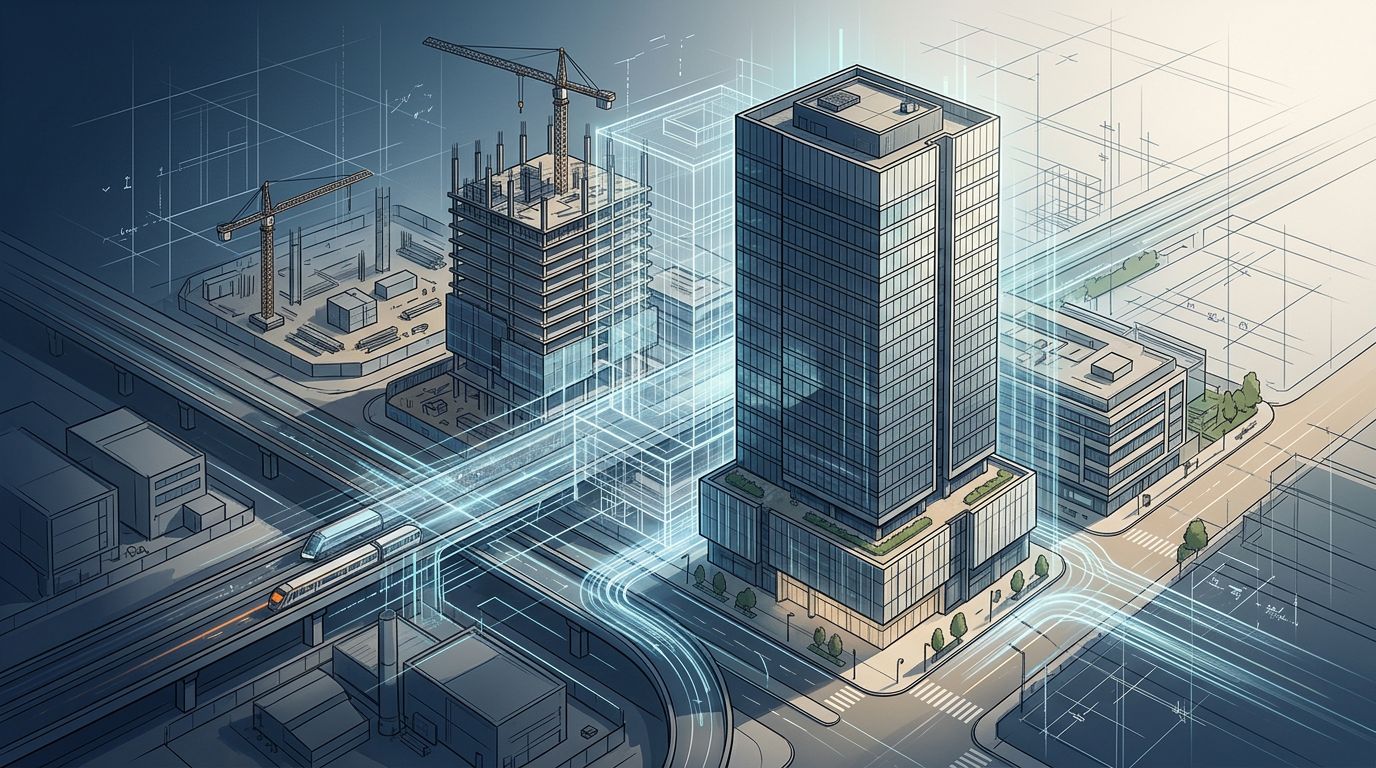
Digital mirrors are becoming one of the most important concepts in modern digital transformation. For decades, organisations relied on backups as their primary insurance against failure and data loss. But in today’s connected business environment—particularly across architecture, engineering and construction (AEC)—preserving the past is no longer enough. Organisations increasingly need systems that reflect operational reality in real time, providing a living view of projects, assets and business performance as they evolve.
The distinction matters more than many business leaders realise. A backup captures a moment frozen in time, useful when something has gone wrong and needs to be restored. A digital mirror, by contrast, continuously reflects the current state of operations, enabling organisations to monitor, respond and adapt before issues become major disruptions.
Across technology ecosystems—from digital twins and BIM environments to cloud infrastructure and AI platforms—mirrored systems are becoming essential for resilience, visibility and smarter decision-making. The question is no longer whether organisations need mirrors alongside their backups, but how quickly they can establish them across their most critical systems. Learn more about Integrated Technology Ecosystems for AEC here.
From Backups to Digital Mirrors
Traditional backups and digital mirrors serve different purposes.
Backups are designed to preserve historical information. They provide a safety net when systems fail, data is corrupted or organisations need to recover previous versions of files. They remain a critical component of any cybersecurity and business continuity strategy.
Digital mirrors, however, focus on the present. Rather than capturing a snapshot at a specific point in time, they maintain an ongoing reflection of operational reality. Changes are synchronised continuously, creating a live representation of systems, projects or assets.
For AEC organisations, this distinction is significant. A backup might contain yesterday’s Revit model. A digital mirror reflects the model as it exists right now, including updates made by project teams across multiple locations only moments earlier.
A useful analogy is to think of backups as a photo album and digital mirrors as a live video feed. Both have value, but they solve different problems. One preserves history. The other enables awareness.
The most resilient organisations use both. Backups provide protection against catastrophic loss, while digital mirrors deliver the visibility and continuity needed to operate effectively in fast-moving environments.
How Digital Mirrors Are Changing the AEC Industry
The AEC sector is undergoing a significant shift from static documentation to connected data environments that continuously reflect project reality.
Historically, project information was distributed across drawings, spreadsheets, reports and email chains. Information moved slowly, creating delays between what was happening on site and what decision-makers could see.
Today, connected platforms are transforming that process. Information flows automatically between systems, allowing stakeholders to access current project status rather than waiting for periodic updates.
When an engineer modifies a design, a contractor updates site progress or a project manager adjusts a schedule, those changes can be reflected immediately across the broader project ecosystem. This creates a shared understanding of project reality that improves coordination, reduces errors and supports faster decision-making.
Digital mirrors are helping organisations move away from reactive project management and towards proactive delivery. Rather than discovering issues after they occur, teams can identify risks earlier and respond while corrective action remains relatively simple and cost-effective.
For organisations managing increasingly complex projects, that visibility is becoming a competitive advantage.
Digital Mirrors and the Rise of Digital Twins
Perhaps the most visible example of digital mirrors in action is the rise of digital twins.
A digital twin is a dynamic virtual representation of a physical asset, building or infrastructure system. Unlike traditional models, digital twins continuously receive data from sensors, operational systems and connected platforms, enabling them to reflect current conditions in near real time.
Across infrastructure and construction projects, digital twins are helping organisations monitor asset performance, optimise operations and predict maintenance requirements before failures occur.
A bridge equipped with sensors can feed information into its digital twin, allowing engineers to identify structural stresses before they become critical. A commercial building can use a digital twin to monitor energy consumption, occupancy patterns and equipment performance, creating opportunities for greater efficiency and sustainability.
The value extends beyond monitoring. Digital twins enable organisations to test scenarios, assess risks and evaluate changes before implementing them in the physical environment.
As digital transformation continues across the AEC sector, digital twins are evolving into one of the most powerful forms of digital mirrors available to project and asset owners. Discover how NexSys can help with your digital transformation here.
BIM as a Living Operational Mirror
Building Information Modelling has also evolved beyond its traditional role as a design and documentation tool.
Modern BIM environments increasingly function as operational mirrors that connect design, construction and project delivery information into a single source of truth.
When integrated effectively, BIM can bring together schedules, procurement data, site progress updates, quality information and cost tracking. Rather than existing as a static design model, it becomes a living representation of project status.
This changes how project teams collaborate.
Instead of relying on multiple versions of documents and drawings, stakeholders work from a shared environment that reflects current conditions. Information becomes more accessible, coordination becomes more efficient and project visibility improves across disciplines.
For organisations embracing digital transformation, BIM is no longer simply about design. It is becoming a central platform for understanding and managing project reality.
Real-Time Visibility Creates Strategic Advantage
The greatest value of digital mirrors is not technological—it is strategic.
Business leaders make better decisions when they have access to accurate, current information. Yet many organisations continue to rely on reports that describe conditions from days, weeks or even months earlier.
Digital mirrors reduce that gap between reality and awareness.
Executive dashboards, operational monitoring platforms and connected business systems can provide continuous visibility into project performance, resource utilisation, financial metrics and operational risks. Rather than waiting for a monthly report to identify problems, leaders can see emerging trends as they develop.
This capability supports faster decision-making, more effective resource allocation and improved risk management.
It also strengthens resilience.
When systems are mirrored in real time, organisations can maintain continuity during disruptions with minimal downtime. Critical operations remain accessible, teams stay productive and projects continue moving forward.
In an increasingly competitive environment, visibility is becoming as important as protection. Organisations that can see what is happening now will consistently outperform those operating from historical information.
AI as a Digital Mirror of Organisational Knowledge
Artificial intelligence introduces another dimension to the concept of digital mirrors.
AI systems increasingly function as reflections of organisational knowledge, processes and decision-making patterns. By analysing project histories, operational data and business workflows, AI can identify trends, surface insights and support more informed decisions.
In many ways, AI acts as a mirror of collective organisational experience.
It captures patterns that would otherwise remain hidden and helps organisations understand what has contributed to successful outcomes in the past. Project risks, procurement trends, coordination challenges and delivery performance can all become more visible through AI-driven analysis.
However, AI also reflects organisational weaknesses.
If historical data contains inconsistencies, gaps or biases, AI systems will often reproduce those same issues. Poor data quality leads to poor reflections.
This makes governance and data management increasingly important. Organisations seeking to leverage AI effectively must ensure that the information feeding these systems is accurate, consistent and trustworthy.
When implemented correctly, AI-powered digital mirrors can help preserve institutional knowledge, support onboarding, improve decision-making and strengthen organisational learning.
Building a Future Powered by Digital Mirrors
The future points towards organisations operating with increasingly sophisticated digital mirrors across every aspect of their business.
Projects, assets, facilities, supply chains and business operations will all have digital counterparts that continuously reflect changing conditions. Physical and digital environments will become more closely connected, creating new opportunities for efficiency, collaboration and innovation.
For AEC organisations, this future is already taking shape.
Connected data environments, BIM platforms, digital twins, cloud infrastructure and AI systems are creating the foundations for continuous operational visibility. These technologies are helping organisations move beyond periodic reporting and towards real-time awareness.
The challenge is no longer technological capability. The technology already exists.
The challenge is developing the processes, governance and culture required to use digital mirrors effectively. Organisations must establish strong data practices, integrate disconnected systems and ensure teams have the skills needed to interpret and act on real-time information.
Those that succeed will gain more than operational efficiency.
They will build resilience, improve decision-making and create a stronger foundation for long-term growth.
Backups will always remain essential. They preserve the past and protect organisations when things go wrong.
But digital mirrors represent something different. They provide a continuous reflection of reality, enabling organisations to understand what is happening now and respond with confidence.
In a world where change happens faster than ever, that visibility may become one of the most valuable assets an organisation can possess.